

Who Is Your Friend?
Everyone knows all that you know and more. More people know all there is to know than you and me. I refer to knowledge with regard to stocks. But knowing more does not mean an ability to be successful if 95% of the information out there is useless. When 95% of the information is useless and everyone knows all the information, then it follows that most people are operating with totally useless information.
The critical information about any stock is always hidden and only the insiders know this crucial information. This have been often repeated my me here and elsewhere. Put yourself in the shoes of an insider. Suppose you have some information that will make you a fortune. But that information can make you a fortune only because you are the only one (and a few of your close and dependable insider friends) with this knowledge. And the reason you will not disclose this to anyone yet is to make sure that you can accumulate as much of this stock as you can. At any strong move upwards, you and your friends will orchestrate a reaction. And at any reaction you will accumulate. And along the way, over time, you will accumulate all that you can accumulate. Eventually, after a long time when the true insider knowledge leaks out over some months and years, and after you and your insiders having made a fortune on a rising stock, all you insiders will slowly and eventually quickly exit.
They say a trend is your friend. If that is the case, can you recognize your friend if you check the charts of these stocks? They could be in an uptrend or could be in a downtrend. There are so many cross currents in the market that any conclusion one way or the other cannot be drawn. You can only know by making the right decision at the right time, at all times. How good of a decision-maker are you? If you are listening to someone else, I am sorry to say, it automatically makes you a poor decision-maker.
I know that I could be wrong and that is fine. That is what makes the market. At any given price there is a seller who thinks that stock has topped out and a buyer to thinks the stocks is on its way up. Both may have a different time horizon for holding a stock and both could turn out to be wrong or both could be right.
Let us do a sample exercise to turn you into a better decision-maker. But this exercise will require you to be completely honest with yourself. Which means you must find the internal discipline to go one chart at a time. Do not peek into the next chart until you have made your decisions on the current chart. For now, let us hide the ticker symbol.
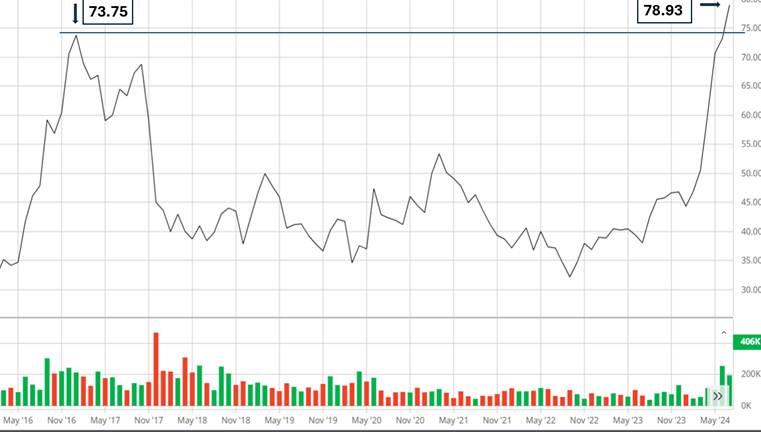
This is Chart 1. It is possible that there is nothing here that offers a clue. For the purpose of this trading exercise, let us suppose you do nothing. Yes, that is an option, to just sit tight and do nothing.
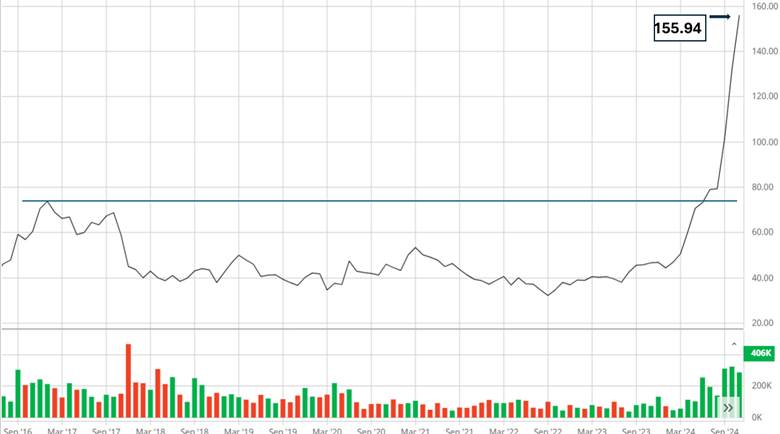
This is Chart 2. Well, you did nothing based on Chart 1. And soon you find that the stock zoomed up to peg a high of 155.94 without any reaction. Remember, you have to make your decision based solely on the current stock. Is there some trade you executed? If so, write it down. Yes, it requires work to actually pull out a sheet of paper and a pencil and enter your decision. If it is too much work, then trading stocks is probably not going to be a successful line of profession.
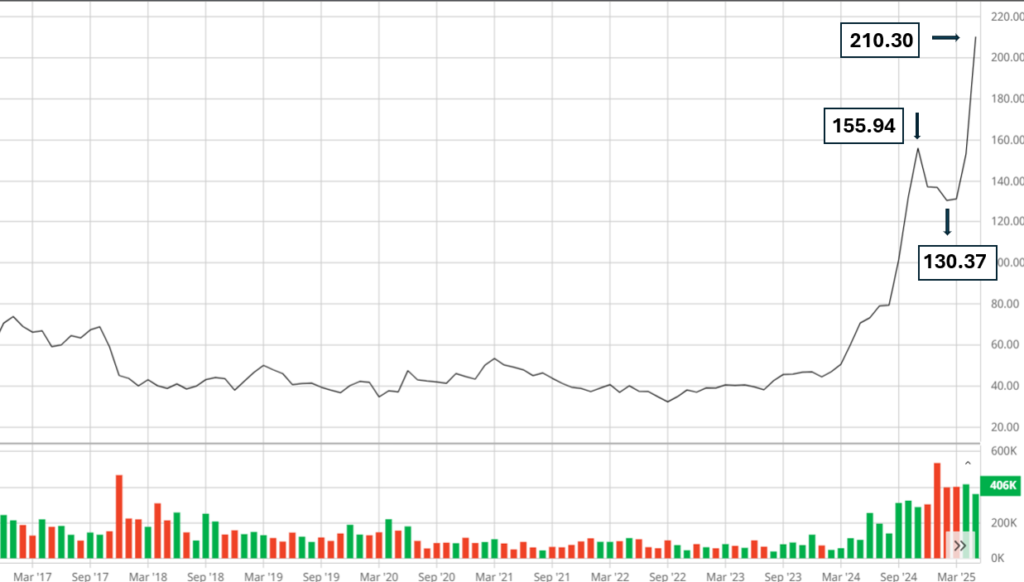
This is Chart 3. Based on what you did or did not do, you have to now make a decision as to what you will do now. Once again, being a disciplined stock operator that you are, write down your trades. This means you have to write down all your decisions and why you made these decisions. Such as, how much of your trading account did you use on the trade? Where is your stop and why? What were the reasons behind the decisions you made?
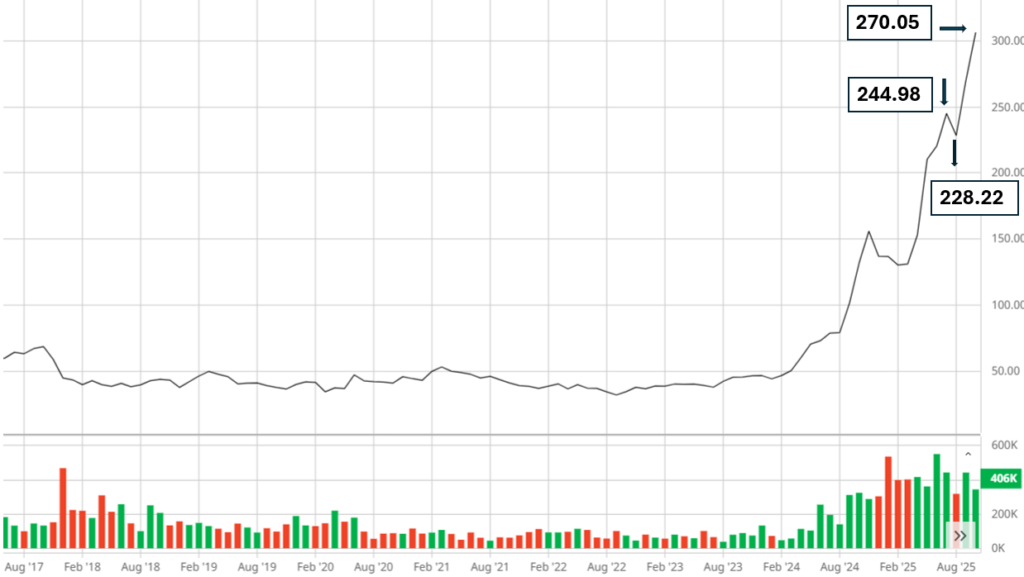
This is Chart 4. Once again, the disciplined operator in you makes the next set of right decisions at the right time. But, what are those decisions? Write them down.
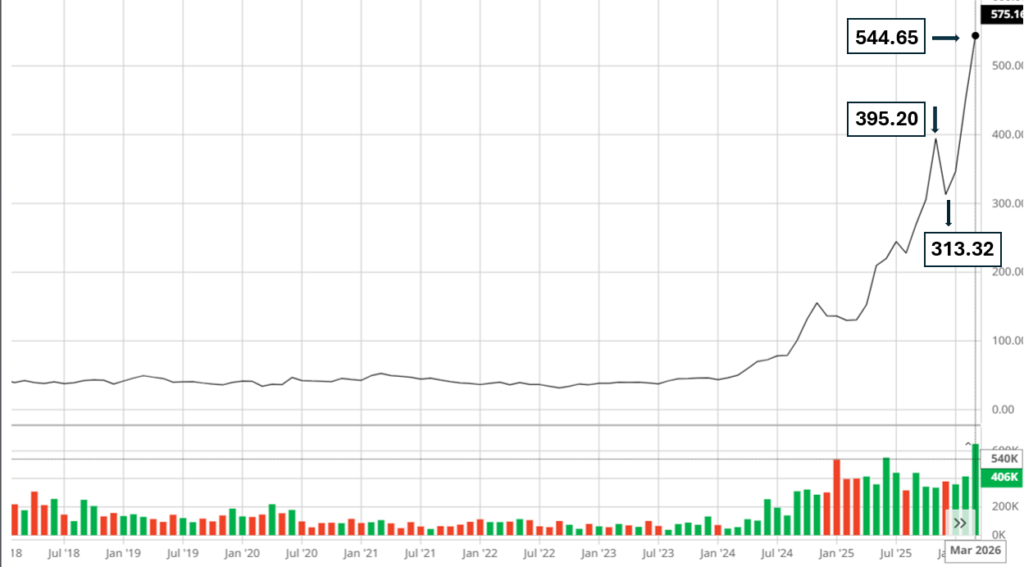
This is the final chart for this exercise. Write down your current set of decisions. And now, I disclose that the charts were all monthly charts. Which has its own challenges. And then I disclose that this is the chart for AGX. And I ask you to look at its weekly charts instead. And you should follow the same discipline and process of going step by step and put yourself in positions where you are required to make critical decisions. Would your decisions have been different if you had used weekly charts?
Here are some questions for you to answer:
What kind of trend do you see when you observe the chart of BKNG? CVNA? Want some more exercises? Try your hand at the downloadable charts below.

 Spanish
  English